A reverse osmosis (RO) membrane does not necessarily need replacing at the same time as every other filter in an RO system. Its service life depends on the system design, incoming water quality, household use, pre-filter condition and the manufacturer’s maintenance requirements.
That means there is no reliable universal replacement interval for every residential RO membrane. The best starting point is the maintenance guidance for your exact system, followed by changes in flow, operation and measured performance. Regular records also make gradual changes easier to recognise before they become disruptive or expensive to diagnose.
Why RO membranes and pre-filters have different schedules
An RO system usually contains several treatment stages. A sediment filter captures suspended particles. Activated carbon may reduce chlorine, taste and odour. The RO membrane then separates part of the dissolved material from the treated-water stream, while a separate concentrate stream carries rejected material away.
Because these stages perform different jobs, they can have different service intervals. Pre-filters may need attention before the membrane. Replacing every component on one generic timetable can mean changing one stage too early while leaving another in service too long.
What affects RO membrane life?
Incoming water conditions
Sediment, hardness and other aspects of water chemistry can change the operating load on an RO system. Two households using the same model may therefore experience different service conditions.
Water consumption
A household producing more RO water puts more throughput through the system. Family size and the amount used for drinking, cooking, tea and coffee can all affect maintenance timing.
Pre-filter maintenance
Timely pre-filter replacement matters. Sediment filters help limit particles reaching later stages, while carbon pre-treatment may protect chlorine-sensitive membrane types. If a pre-filter becomes restricted or exhausted, water production and membrane operating conditions may be affected.
Signs that your RO system needs checking
Do not wait for the water to look dirty. Arrange an inspection when you notice:
- a sustained reduction in purified-water flow;
- a filter or membrane warning from the system;
- an unexplained change in taste or system operation;
- a material change in treated-water performance; or
- the membrane reaching the inspection or service point specified for the model.
These signs do not prove that the membrane has failed. Reduced flow, for example, may result from a blocked pre-filter, incoming pressure, a valve or another component. Check the whole system before ordering a replacement membrane.
Can a TDS meter tell you when to replace the membrane?
A TDS meter can help track changes in dissolved-solids readings, but it is not a universal water-safety test. Recording incoming and treated-water readings while the system is operating normally gives you a useful baseline. A later change may justify further investigation.
However, TDS does not identify individual substances and cannot confirm whether microorganisms, PFAS or a specific metal is present. Use it as one maintenance indicator—not as proof that the water is safe or that the membrane must be replaced.
Check the exact HG PureWater model
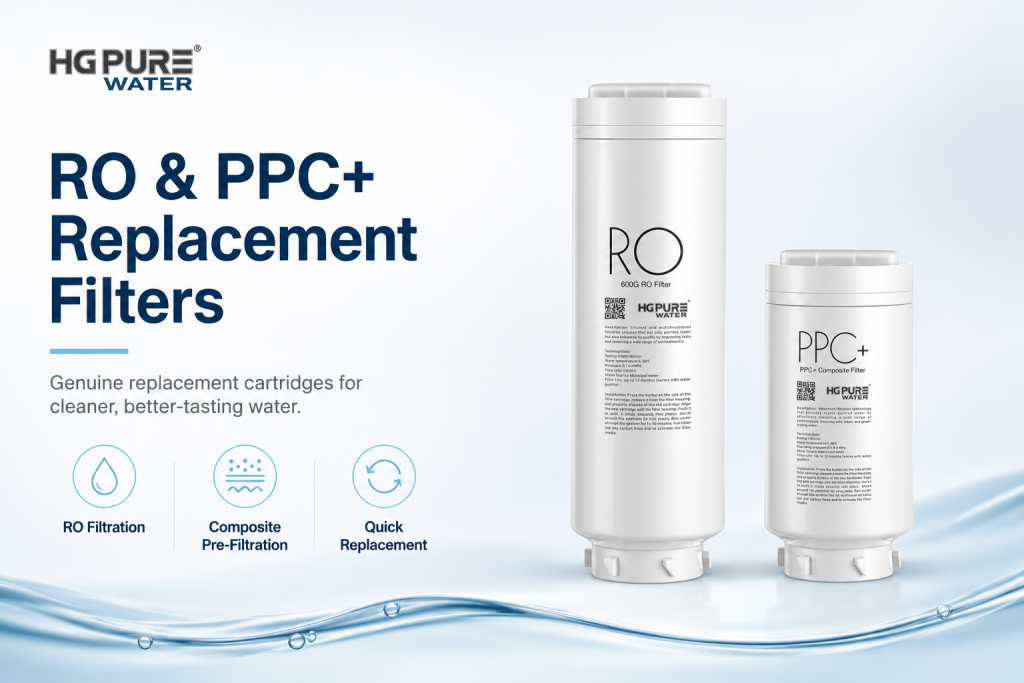
HG PureWater replacement components are model-specific. The HGH-26 Compact Reverse Osmosis System uses a multi-stage filtration configuration. HG PureWater’s current maintenance guide lists both HGH-26 replacement cartridges at approximately one year, depending on water quality and use. This is a cartridge guideline; it must not be presented as a universal RO membrane lifespan.
Other HG PureWater RO systems use different filter arrangements and schedules. Confirm the model label before purchasing replacement filters. If you are unsure, send HG PureWater a clear photo of the system and its label.
A simple RO maintenance routine
Keep a record of the installation date, model, cartridge changes and any unusual change in flow or operation. Follow the correct flushing or reset procedure after servicing. Where performance has changed, diagnose the system rather than automatically replacing every component.
Correct, model-specific maintenance is more useful than relying on a generic replacement rule. Contact HG PureWater if you need help identifying your system or the correct replacement component.