
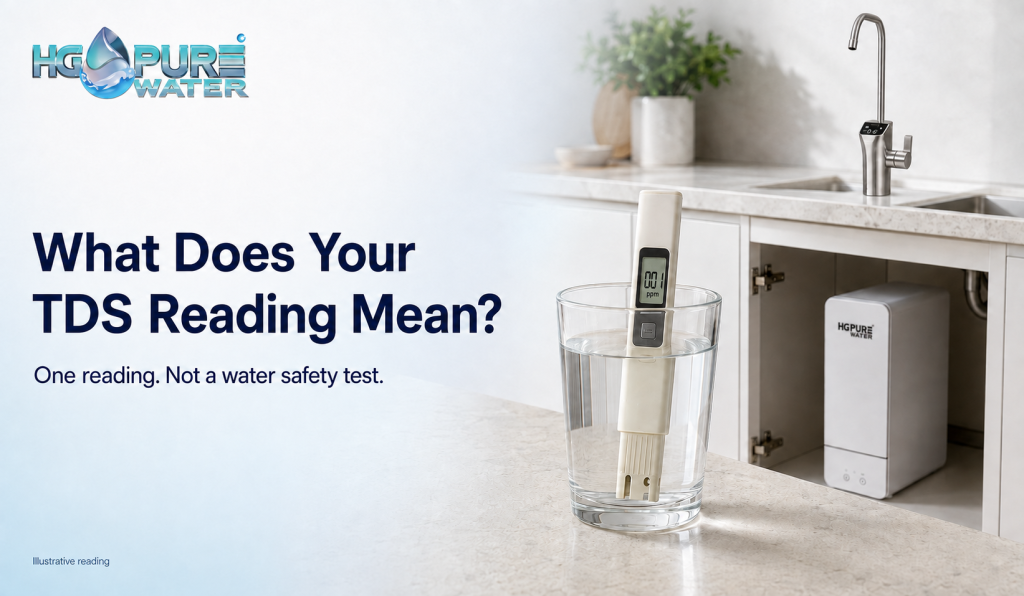
A handheld TDS meter gives Australian households a quick way to compare tap water and filtered water. Dip the probe into a clean sample and a number appears, usually in parts per million. But what does that number actually tell you?
The important distinction is that most consumer meters estimate total dissolved solids from electrical conductivity. They do not identify everything in the water, and a low reading is not a certificate of safety.
What is TDS in drinking water?
TDS stands for total dissolved solids. These can include naturally occurring minerals and salts, such as calcium, magnesium, sodium, chloride, bicarbonate and sulphate, as well as other dissolved material.
The Australian Drinking Water Guidelines do not set a health-based guideline value for TDS itself. Their 600 mg/L reference relates to good palatability, not a boundary between safe and unsafe water. Individual substances still need to be assessed against the guidance relevant to them.
Higher readings may accompany a salty or mineral taste, but TDS is not a hardness test. It cannot establish how much scale a particular water supply will produce. Read the national guidance here: https://guidelines.nhmrc.gov.au/australian-drinking-water-guidelines/part-5/physical-chemical-characteristics/total-dissolved-solids
How does a handheld TDS meter work?
Most consumer TDS meters measure electrical conductivity and convert it into an estimated dissolved-solids value. Dissolved ions carry electrical current; the meter does not collect and weigh every dissolved substance.
The mineral mixture, temperature and conversion factor affect the estimate. Two meters using different factors may display different numbers for the same sample. For consistent comparisons, follow the meter’s calibration instructions, use clean containers and let the reading stabilise.
Instrument manufacturer Hanna explains this conversion and the influence of temperature: https://blog.hannainst.com/electrical-conductivity-the-ultimate-guide
What can a TDS reading help you check?
- Changes in the same water supply over time.
- Differences between incoming water and RO-treated water.
- An unexpected change that warrants a system inspection or further testing.
Record the sampling point, date and operating conditions alongside the number. A reading taken after water has passed through a remineralising stage may differ from one taken directly after the RO membrane. Compare like with like rather than chasing the lowest possible number.
For servicing decisions, see our RO membrane maintenance guide. A meter reading alone does not establish that a membrane needs replacing.
Does low TDS mean drinking water is safe?
No. A meter cannot identify individual contaminants. Similar readings can come from different mixtures of dissolved material, while substances present at very low concentrations may not noticeably change the reading.
Do not use a handheld TDS meter to confirm the absence of PFAS, lead, arsenic, pesticides or microorganisms. A high result does not automatically mean water is unsafe, and a low result does not prove it is safe. Specific concerns require appropriate testing, not just a conductivity estimate.
For a private bore or rainwater supply, discuss the source and intended use with a laboratory to select suitable chemical and microbiological tests. Our private-source PFAS testing guide covers that particular concern; a PFAS test alone is not a complete assessment. Always follow any drinking-water advisory issued by the relevant authority.
Why different filters affect TDS differently
Sediment filtration targets particles, while activated carbon addresses selected substances and taste or odour concerns. These stages do not normally remove substantial amounts of dissolved salts. A water softener primarily exchanges hardness ions and should not be judged by whether it produces low-TDS water.
Reverse osmosis is different: its membrane can reduce dissolved salts. The HG PureWater HGH-24 is a tankless under-sink RO system for drinking and cooking water. Its product page lists an 800 GPD membrane and flow up to approximately 2.1 litres per minute under suitable conditions. These specifications do not establish suitability for every source or contaminant.
Choose treatment for the problem, not the number
Start with your water source, the concern you want to address and any relevant laboratory results. Contact HG PureWater to discuss appropriate options. A TDS meter provides one useful indicator, not a complete description of drinking-water quality.
Verified sources and evidence checked 3 September 2026: NHMRC Australian Drinking Water Guidelines, Hanna Instruments and the HGH-24 product page linked above.