
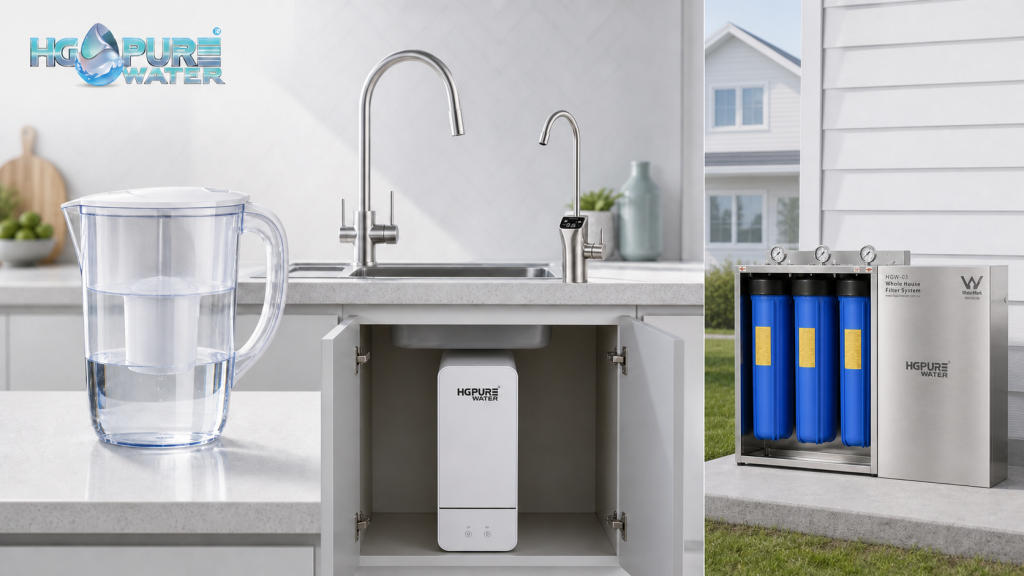
A water filter jug can be a practical and inexpensive way to improve the taste of a small amount of drinking water. An installed filtration system generally offers greater capacity and convenience, but it also costs more and requires suitable plumbing and installation space.
Neither option is automatically right for every household. The better choice depends on where treatment is required, how much water is used and what specific water concern needs to be addressed.
What Is a Water Filter Jug?
A filter jug is filled manually and normally uses a replaceable cartridge containing activated carbon and, depending on the product, other filtration media.
The water moves through the cartridge and collects in the lower section of the jug. It can then be stored in a refrigerator or placed on a kitchen bench.
Filter jugs are generally intended for relatively small quantities of drinking water. Their exact filtration performance depends on the cartridge and any testing or certification applying to the specific model.
A jug should not be assumed to reduce a substance simply because its cartridge contains activated carbon.
When Does a Filter Jug Make Sense?
A filter jug may be suitable when:
- You are renting and cannot modify the plumbing
- Only a small quantity of drinking water is required
- The household wants a low initial purchase cost
- Bench or refrigerator storage is available
- Manual filling is not inconvenient
- The cartridge has suitable evidence for the intended purpose
- A permanently installed system is not currently practical
What Are the Limitations of a Filter Jug?
The main limitations relate to capacity and daily convenience.
A jug must be refilled whenever the treated water is used. Larger households may need to fill it several times per day and wait for water to pass through the cartridge.
Other practical considerations include:
- Limited storage capacity
- Refrigerator or benchtop space
- Regular cleaning
- Cartridge replacement
- The cost of replacement cartridges
- Remembering the replacement date
- The possibility of untreated and treated water being confused
A jug also cannot address general water concerns throughout the property. For example, it does not treat shower water or reduce sediment entering connected appliances.
What Is an Installed Under-Sink System?
An under-sink filtration system connects to the kitchen water supply and provides treated water through a dedicated outlet or suitable mixer tap.
Unlike a jug, it does not need to be manually filled. Water is treated when the household uses the drinking-water outlet.
Different under-sink systems perform different functions. A carbon system may focus on chlorine taste and odour, while reverse osmosis uses membrane separation together with supporting filtration stages.
HG PureWater’s HGH-24 and HGH-26 are under-sink RO systems intended primarily for drinking, cooking, tea and coffee. Product selection should still be based on the incoming water, required flow, available cabinet space and supporting product evidence.
How Does Whole-House Filtration Differ?
A whole-house filter is installed near the main water entry rather than beneath the kitchen sink.
It treats incoming water before it reaches connected taps, showers, bathrooms and the laundry. This makes it suitable when the concern affects general-use water across several areas of the home.
The HGW-03 uses a PP sediment cartridge, carbon block and granular activated carbon. It is intended to help reduce suspended particles and chlorine taste and odour in treated mains water.
A whole-house filter is not simply a larger version of a filter jug. It must support much higher flow and should be correctly sized and installed for the property.
Which Option Is More Convenient?
A filter jug requires no permanent plumbing, but it must be filled, stored, cleaned and maintained manually.
An under-sink system provides drinking water directly from a dedicated outlet. A whole-house system treats water automatically as it enters the property.
Installed systems usually offer greater capacity and convenience, but they involve:
- Higher initial cost
- Installation requirements
- Space and plumbing considerations
- Scheduled cartridge or membrane replacement
- Possible professional servicing
Which Option Should You Choose?
Choose a filter jug when the requirement is small, temporary or limited to basic drinking-water use and the exact cartridge has suitable evidence for the intended purpose.
Consider an under-sink system when the priority is convenient treatment for drinking and cooking water.
Consider whole-house filtration when sediment or chlorine taste and odour need to be addressed across multiple connected outlets.
Before purchasing, confirm your water source, main concern, household demand and available installation space. If a specific contaminant is suspected, obtain appropriate water-quality information and check evidence for the exact filtration model.
Send HG PureWater your postcode, water source, main concern and site photos for help comparing an under-sink RO system, whole-house filtration or another suitable option.